

Historic Christian writings, made more accessible for modern readers.
Founded in 2024, Church Writings is building a cleaner way to explore, read and connect the Christian tradition. The platform combines a growing digital library of Scripture, the church fathers, the martyrologies and the confessions with modern tooling, so readers can discover texts, trace the connections between them, and return to the historic faith with clarity.
- Founded
- 2024
- Works
- 749
- Authors
- 101
- Chapters
- 27,647
- Centuries
- 14
- Always
- Free
Christian Wisdom Accessible for All
Most of what the church has written is public, and almost none of it is easy to find. The texts sit behind scanned pages, broken links, and editions that assume you already know what you are looking for. We think a reader who has never opened a church father should be able to start reading in under a minute.
So the library is free, the texts are unabridged, and nothing is locked behind an account. Our work is to keep adding writings, keep the reading experience quiet, and keep the connections between them visible, so that one page leads honestly to the next.
What is on the shelves.
Scripture, the church fathers, the martyrologies and the confessions, kept in plain, readable editions and grouped so you can see where a text sits in the tradition. Every count below is the number of works in that section today.
Holy Bible
80 worksComprising the Old and New Testaments, stands as the sacred scripture for Christians worldwide.
Ante Nicene
391 worksThe writings of the church's first three centuries, from the apostles' own pupils to the eve of Nicaea.
Nicene and Post-Nicene
203 worksThe great age of the Fathers after Nicaea, when the creeds were settled and the classics of Christian teaching written.
The Great Awakening
29 worksThe preachers and theologians of the transatlantic revivals, and the movements that carried their fire onward.
Medieval Theologians
16 worksA thousand years of monks, mystics, and schoolmen, from Bede and Anselm to Aquinas and Julian of Norwich.
Ecumenical Councils
11 worksThe seven councils in which the whole church met to say together what it believes about Christ.
Puritan & Quaker Writers
11 worksEnglish and New England divines on the searching of the heart, alongside the early Quakers on conscience and peace.
Renaissance
3 worksChristian humanism, letters, and devotion in the years when Europe was rediscovering its own sources.
Anabaptist Thinkers
3 worksThe radical reformers who baptized on confession of faith, and the martyr writings their movement produced.
Jewish History
2 worksJewish historians and philosophers whose work opens up the world in which the Scriptures were written.
Tools Built to Engage the Text.
The reading itself is old. The way you move through it does not have to be.
Connected reading
Every reading opens beside what it echoes. The side panel gathers the passages a line quotes, answers or argues with, so a sentence in Irenaeus leads straight to the Scripture behind it.
Search that knows the corpus
Search by phrase, author, century or theme across all 749 works at once, rather than one book at a time.
Two ways to browse
The same library ordered by century or by tradition. Read Augustine as a voice of his own century, or beside the theologians he went on to shape.
A dictionary of the tradition
109 entries on the terms, councils and controversies these writers assume you already know, linked from the texts that use them.
Editions side by side
Where a work exists in more than one translation, or in a modernised text, the versions sit together so you can compare a passage rather than take one rendering on faith.
Highlights that stay
Mark a passage and it is waiting for you the next time, gathered in one place instead of scattered across the books you found it in.
Listen to the early Christians.
Every recording is read by a volunteer, unabridged and without music. Nothing here is synthesised and nothing is abridged for time. The first recordings are in production, and the shelf below is what is being read now.
Proof of Apostolic Preaching
First Epistle to the Corinthians
The Pastor of Hermas
Dialogue with Trypho
Who is building it?
Two readers in Boston who wanted this to exist.

Max Secor
Co-founder
Max is a machine learning scientist and former missionary who loves reading early Christian literature and engaging with the historic faith. He lives in Boston with his wife and two children and enjoys the fellowship of like-minded believers from every Christian background. His goal is to see more people read the works of faithful Christians who came before him.
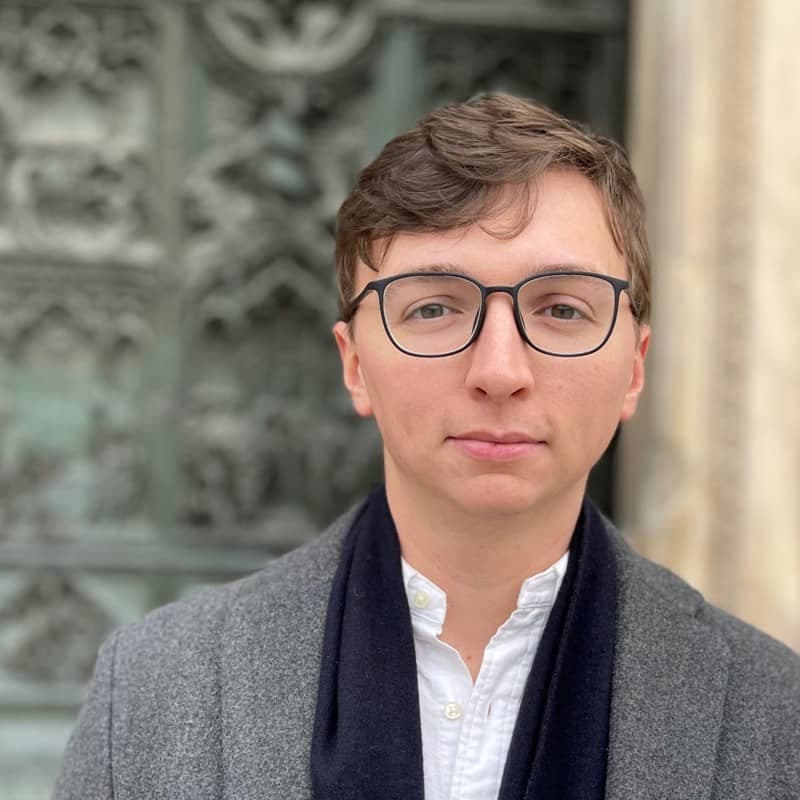
Tom Kruger
Co-founder
Tom is a software engineer based in Boston, where he lives with his wife and three children. He spent the majority of his adult life in China, working across cultures and languages. His deep love for the Christian faith and its history, spanning East and West, ancient and modern, shapes much of his life and work. Through Church Writings, Tom seeks to modernize and make accessible the vast treasury of Christian literature.